


How Can a High School Student Prepare for Architecture School?

Updated: Aug 29
If you are a high school student dreaming about becoming an architect, you may imagine that preparing for architecture school means learning how to draw buildings, understanding floor plans, mastering architectural software or studying famous architects. These things can eventually become useful, but I believe there is something much more important you should develop before university. You should begin discovering how you see the world differently from everybody else. Architecture schools can teach you architecture, but the most valuable thing you can bring with you is something no university can manufacture for you: curiosity, imagination, creative courage and the beginnings of your own personal way of thinking.
This is the foundation of my approach to preparing high school students for architecture school. As Moshe Katz Architect, I do not try to turn teenagers into miniature professional architects before they arrive at university. I want to do almost the opposite. I want to protect and expand the freedom they still have before architectural conventions become deeply established. I want students to experiment with drawing, photography, model making, observation, storytelling, materials, nature, emotions and unexpected ideas so that when they eventually enter architecture school, they arrive not simply knowing a few architectural techniques, but already beginning to understand themselves as creative people.
The question How Can a High School Student Prepare for Architecture School? therefore has a much more exciting answer than simply preparing an architecture portfolio. You can begin preparing the creative mind that will eventually create the architecture.
How Can a High School Student Prepare for Architecture School?
The best place to begin is not with buildings. Begin with curiosity.
Look around you and notice what attracts your attention naturally. Perhaps you are fascinated by shadows moving across your bedroom wall. Perhaps you love abandoned buildings, insects, clouds, fashion, machines, trees, ceramics, music, photography, Japanese culture, cities at night or the movement of people through crowded streets. Perhaps you collect unusual objects or continuously draw faces in the margins of your notebooks.
Do not dismiss these interests because they do not appear architectural.
They may eventually become the most architectural things about you.
One of the central ideas behind my Teen Architect Program and architecture portfolio mentoring is that creativity often begins outside architecture. If every student begins by looking at the same famous buildings, studying the same architects and copying the same architectural images, their work can quickly become predictable. Instead, I encourage students to bring their own world into architecture.
The question changes from “What should an architecture student create?” to “What could architecture become when it passes through me?”
That is a much more powerful beginning.

Train Yourself to Observe Before You Learn to Design
Before learning how to design buildings, learn how to see.
Architects notice relationships that other people may pass without seeing. They notice how morning light changes a room, how people choose one route through a public square rather than another, how a tree bends toward sunlight, how two materials meet, how shadows reveal geometry and how a narrow street suddenly opens toward the sky.
Observation is one of the greatest creative exercises available to a future architecture student because the world becomes your classroom.
Carry a sketchbook. Draw objects around you, but do not worry about making perfect drawings. Photograph unusual spatial situations. Collect textures. Draw the movement of people. Study how fabric folds. Look at the structure of leaves, shells and wings. Observe how water flows around obstacles. Sketch the rhythm of windows across a street.
Then go further.
Ask why something interests you.
This is where observation becomes creative research.
Learn Architectural Sketching as a Way of Thinking
Many high school students tell me they are worried because they cannot draw realistically. I do not believe architectural sketching should begin with the fear of whether a drawing is beautiful enough.
A sketch is a thinking instrument.
You can use architectural sketching to observe, question, imagine and transform. One sketch may record a place. Another may capture movement. Another may express an atmosphere. A conceptual sketch might consist almost entirely of lines, arrows, fragments and notes because its purpose is not to create an artwork. Its purpose is to make an invisible idea visible.
This distinction is extremely important when preparing an architecture school admission portfolio.
Universities are not simply looking for students who can produce polished pictures. A powerful portfolio can reveal intellectual and creative movement. It can show how you discovered something, investigated it, interpreted it and eventually transformed it into something new.
Learn to draw what you see, but also begin learning to draw what you think.
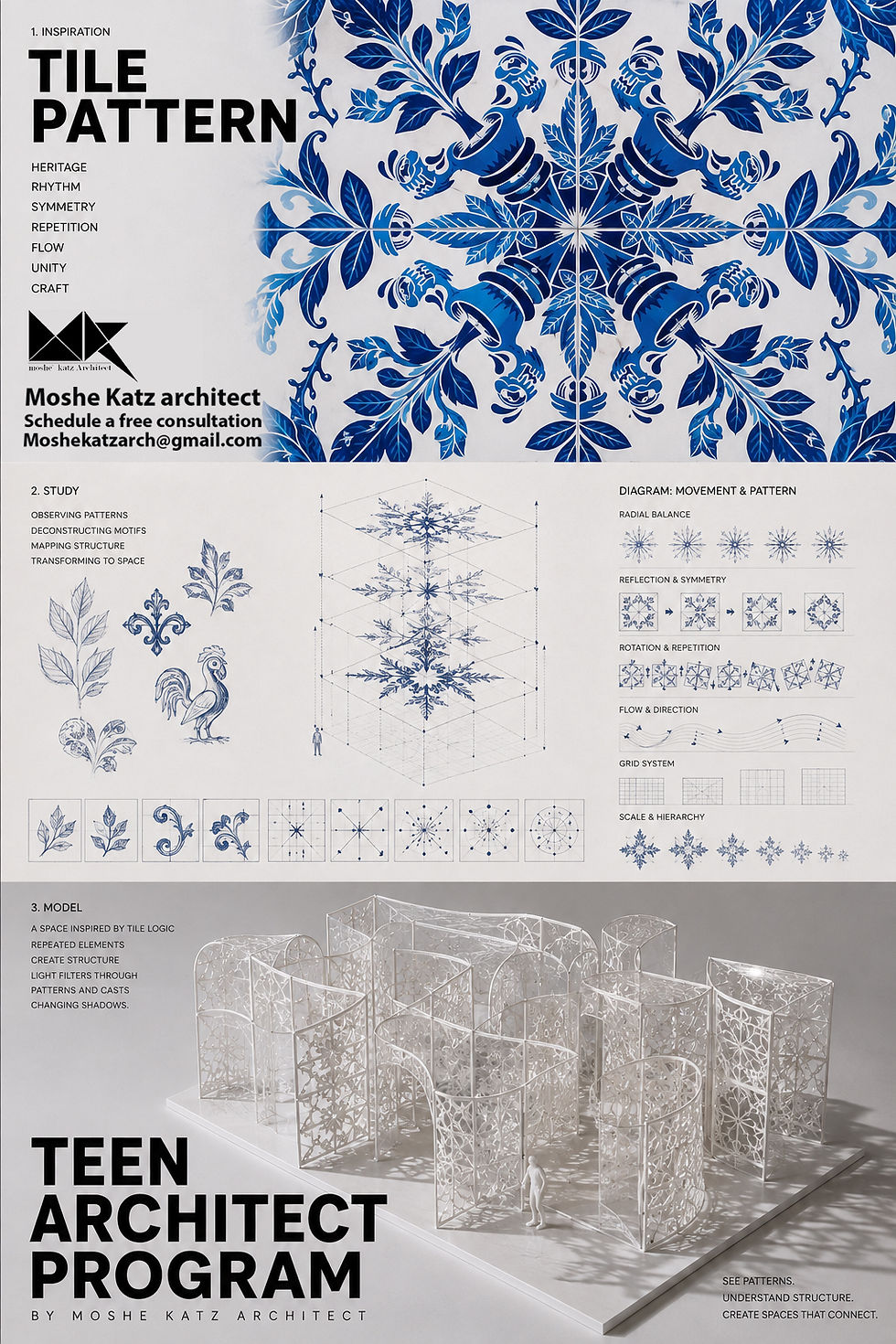
Make Things with Your Hands
Another essential part of preparing for architecture school is model making, but I encourage students to approach models very differently from the conventional miniature building.
Take cardboard, paper, wire, thread, bamboo, fabric, clay, transparent sheets, recycled materials or anything else that fascinates you and begin experimenting.
Fold something.
Stretch something.
Suspend something.
Cut openings into something and place it beside a window.
Photograph the shadows.
Change the material.
Combine two systems.
Ask what happens when gravity enters the experiment.
You may not know what you are creating yet, and that uncertainty is valuable.
The model becomes a laboratory.
Eventually, perhaps one folded surface begins suggesting shelter. A stretched fabric creates a surprising interior. A suspended structure produces an unusual relationship between body and gravity. Only then should you begin asking what kind of architecture might emerge from the discovery.
This develops one of the most important abilities an architecture student can possess: the capacity to discover rather than merely execute.

Learn to Transform Inspiration into Architecture
One of the central creative processes I teach begins with inspiration and gradually transforms it.
Imagine that you become fascinated by a jellyfish.
The beginner might design a building shaped like a jellyfish.
I would encourage you to go deeper.
What interests you about it? Transparency? Floating? Movement? The relationship between a central body and delicate extensions? The way it changes form while moving through water?
Now isolate that principle.
Sketch it.
Diagram it.
Create a material experiment based on it.
Transform the experiment.
Imagine a person entering it.
Suddenly you are no longer copying the appearance of a jellyfish. You are translating an idea discovered through the jellyfish into spatial thinking.
That transformation is architecture.
Learning this process before university can give a high school student an extraordinary foundation because architecture school constantly asks you to transform abstract ideas into spatial propositions.

Do Not Rush to Look Like an Architecture Student
There is a strange paradox in architecture portfolio preparation. Students sometimes try so hard to make their work look professional that they remove exactly what could make it memorable.
Perfect computer renders, technical plans and sophisticated architectural drawings may look impressive, but they do not automatically reveal imagination.
If you are seventeen years old, I want to see seventeen years of life entering your portfolio.
Show me what fascinates you.
Show me the strange photograph you took because nobody else noticed what you noticed.
Show me your experimental model.
Show me the sketch where an unexpected idea appeared.
Show me the project that did not work and what you discovered because of it.
Show me how your thinking changed.
A compelling high school architecture portfolio should not pretend that you are already an architect. It should make people excited about the architect you might become.
Build a Portfolio as a Story About You
This is where architecture portfolio preparation becomes much deeper than collecting projects.
When I mentor a student, I look across everything they have created and search for patterns. Perhaps movement keeps appearing. Perhaps they are fascinated by transformation, identity, memory, nature, fragmentation, light, cultural rituals or hidden worlds.
Often students do not recognize these patterns themselves.
But when we place their work together, something begins emerging. I think of this as discovering their creative DNA.
This can eventually lead to an umbrella concept for the architecture portfolio. Instead of presenting unrelated assignments, the portfolio becomes a story about how one young person experiences reality.
Each project becomes a chapter.
The portfolio develops rhythm, personality and meaning.
This is particularly powerful for university architecture admissions because the viewer is no longer simply remembering individual images. They begin remembering the person behind them.

Learn to Explain Why
One word can radically improve almost every student project: why.
Why did you choose this subject?
Why does this material matter?
Why did the model transform?
Why did you photograph this place?
Why should somebody experience this space?
Why does this project belong to you?
Students frequently concentrate on what they made. Architecture becomes much stronger when they can communicate why they made it.
This is also the foundation of architectural storytelling. A project can begin with curiosity, develop through research and experimentation, encounter discoveries and eventually become a spatial proposition. When you learn to communicate this journey, your portfolio becomes evidence of your creative process rather than simply a gallery of outcomes.
Architecture School Preparation Should Develop You, Not Only Your Portfolio
This is where my approach to tutoring differs from portfolio preparation that concentrates primarily on assembling pages.
Of course, we want to create an exceptional architecture portfolio for university admission. But I consider the portfolio almost a consequence of something larger.
I want to develop the student.
Through my work as Moshe Katz Architect, I mentor high school students through a personalized creative journey involving observation, intuitive and conceptual sketching, creative research, diagrams, photography, model making, architectural storytelling, experimentation, portfolio development and presentation. We look at what already exists, discover strengths that may be hidden inside it and develop new directions that belong specifically to that student.
I do not want every student leaving my mentoring to produce work that looks like mine.
That would defeat the purpose.
I want their work to look increasingly like themselves.

Why Starting Before Architecture School Can Change Everything
The greatest advantage of preparing early is not simply having more time to produce a portfolio. It is having time to experiment without desperately trying to reach a final answer.
Creative development needs space.
You can explore photography for several weeks and discover that it changes your drawing. You can investigate movement and realize that it becomes a recurring theme. You can build models without knowing where they will lead. You can develop projects, reconsider them and gradually recognize your strengths.
By the time university applications arrive, you are no longer desperately asking, “What should I put in my architecture portfolio?”
You already have a body of discoveries.
More importantly, these discoveries do not disappear after admission. The ability to observe, research creatively, develop concepts, sketch ideas, make experimental models, communicate visually and understand your own creative process can accompany you through architecture school and into your future professional career.
This is why I see my Teen Architect mentoring as preparation for much more than getting accepted.
It is preparation for becoming.
Preparing for the Architect You Might Become
Ultimately, How Can a High School Student Prepare for Architecture School? The answer is not to become an architect before architecture school.
Become curious.
Become observant.
Become experimental.
Learn to draw thoughts as well as objects. Learn to make things before knowing exactly what they will become. Search outside architecture for inspiration. Transform what fascinates you rather than copying its appearance. Ask questions. Take creative risks. Learn to explain why. Begin recognizing the patterns that make your way of seeing different from somebody else's.
And if you work with me through my Teen Architect Program and architecture portfolio tutoring with Moshe Katz Architect, this is precisely the journey I want us to take together. We will not simply ask how to make your portfolio look impressive. We will search for the creative person who should exist behind that portfolio and develop a personalized process around your interests, strengths and potential.
Because the strongest preparation for architecture school is not arriving with all the answers.
It is arriving with an extraordinary ability to discover.
Your portfolio can then become evidence of that ability, a visual story that says something far more exciting than “I already know architecture.”
It can say, “This is how I see the world. This is how I think. This is what I am beginning to discover. Imagine what I might become.”
That is where the journey toward architecture truly begins.
#ArchitectureSchool #ArchitectureSchoolPreparation #HighSchoolArchitecture #TeenArchitect #ArchitecturePortfolio #ArchitecturePortfolioPrep #ArchitecturePortfolioPreparation #ArchitectureSchoolPortfolio #ArchitectureAdmissionPortfolio #HighSchoolArchitecturePortfolio #ArchitectureTutor #ArchitectureTutoring #ArchitectureMentor #MosheKatzArchitect #FutureArchitect #ArchitectureStudents #ArchitectureAdmissions #ArchitectureSketching #ConceptualSketching #ModelMaking #ArchitectureModels #CreativeThinking #CreativeProcess #DesignProcess #CreativeDNA #ArchitecturalStorytelling #ArchitectureEducation #ArchitectureForTeens #ArchitecturePortfolioTutor #ArchitectureMentoring


Comments