


Let the Building Teach You to Let Go: The Practice of Spiritual Architecture

Updated: Aug 29
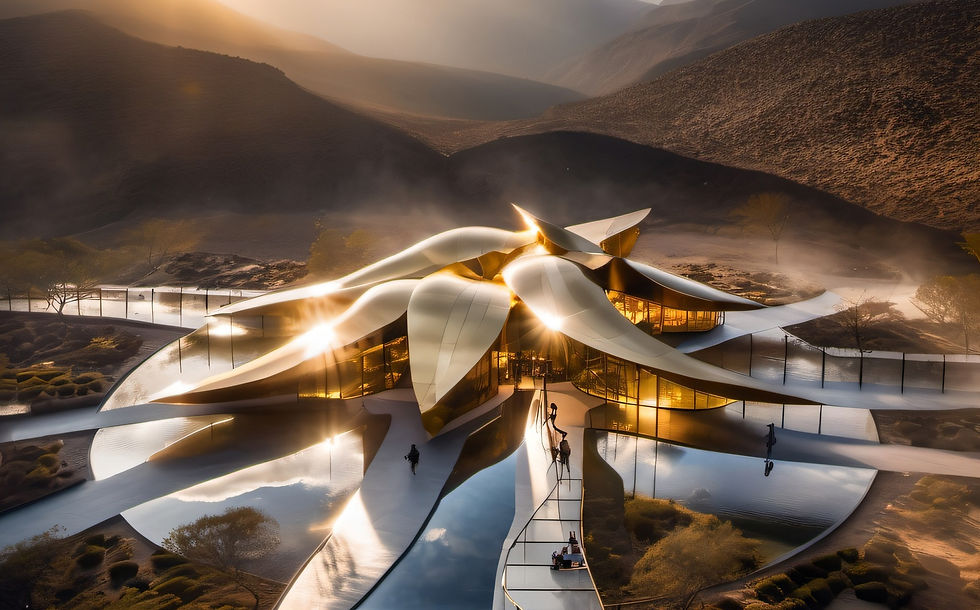
Spiritual architecture is a teacher. It can train the ego to accumulate, or it can train the soul to release. Choose the latter. Design with humility and empathy: go barefoot on the site, listen to the wind, feel the pulse beneath your feet. Lead with intuition. The method is simple and powerful: connect to the Infinite within you, daydream with purpose, narrow toward essence, design the experience first, and infuse every detail with spirit.

Geometry becomes a language of unity: circles and domes hint at infinity; spirals and Möbius-like ramps offer unbroken continuum; the dot, line, plane and volume become carriers of meaning. Align structures with celestial markers; orient an oculus so that on a solstice the altar bathes in golden light. Use scale to open the heart — place someone in a space many times their height and watch humility bloom into awe.
Embrace impermanence. Choose materials that age and teach: wood that softens, metal that patinas, water that reflects seasons. Build thresholds and voids that invite stillness. Narrow a corridor to quiet the mind; place a bench that asks for waiting; carve an empty sanctuary that functions as a mirror. In such spaces, emptiness is not absence but presence — a place where one meets true size and opens.
Finally, remember the role of sound, story and word. Let language move through your screens and panels so that prayer and poem become living shadow. Compose soundscapes that calm collective anxiety and spark communal creativity. Design not only for bodies but for hearts and minds; let your buildings be prototypes for human evolution.
Spiritual design is not a style; it is a practice. When you commit to building with intention, humility and creative rigor, your spaces will do what they are meant to do: awaken wonder, foster connection, and hold the sacred in the cadence of everyday life.
#unity #spiritualarchitecture #spiritualdesign #moshekatzarchitect #wellbeingdesign #spiritualityinarchitecture #spirituality #spiritualart #poeticarchitecture #designinfinity


Comments