


Pop‑Up Architecture: How to design the Temporary City From the Book- POP UP architecture by Moshe Katz

Updated: Aug 29
Once you stop seeing cities as static collections of buildings and begin to read them as living, temporal systems, a new architectural logic emerges: pop‑up architecture. This book reframes design from permanence to moment — arguing that the most powerful interventions are often brief, precise, and perfectly timed. The result is a portrait of a city that breathes, experiments, heals, and moves.
The core idea is simple and thrilling: permanence has dominated architectural thinking, but urban life is inherently transient. Streets pulse with rhythms, corners sleep and suddenly awaken, squares are lively at some hours and empty at others. Pop‑up architecture accepts temporality as a design condition. Its aim is not to erect lasting monuments but to create moments that change how places are perceived and used — leaving behind memory and possibility rather than concrete.
What pop‑up architecture is goes beyond temporary objects. It’s a philosophy of intervention: responsive, contextual, and intentional. A pop‑up is meaningful because it answers a local need or condition — a café that animates a dead plaza, a light installation that redraws nocturnal movement, a shelter that becomes a temporary neighborhood hub. Mobility, modularity, and immediacy are not gimmicks but strategies that let interventions enter fast, register clearly, and leave light traces.
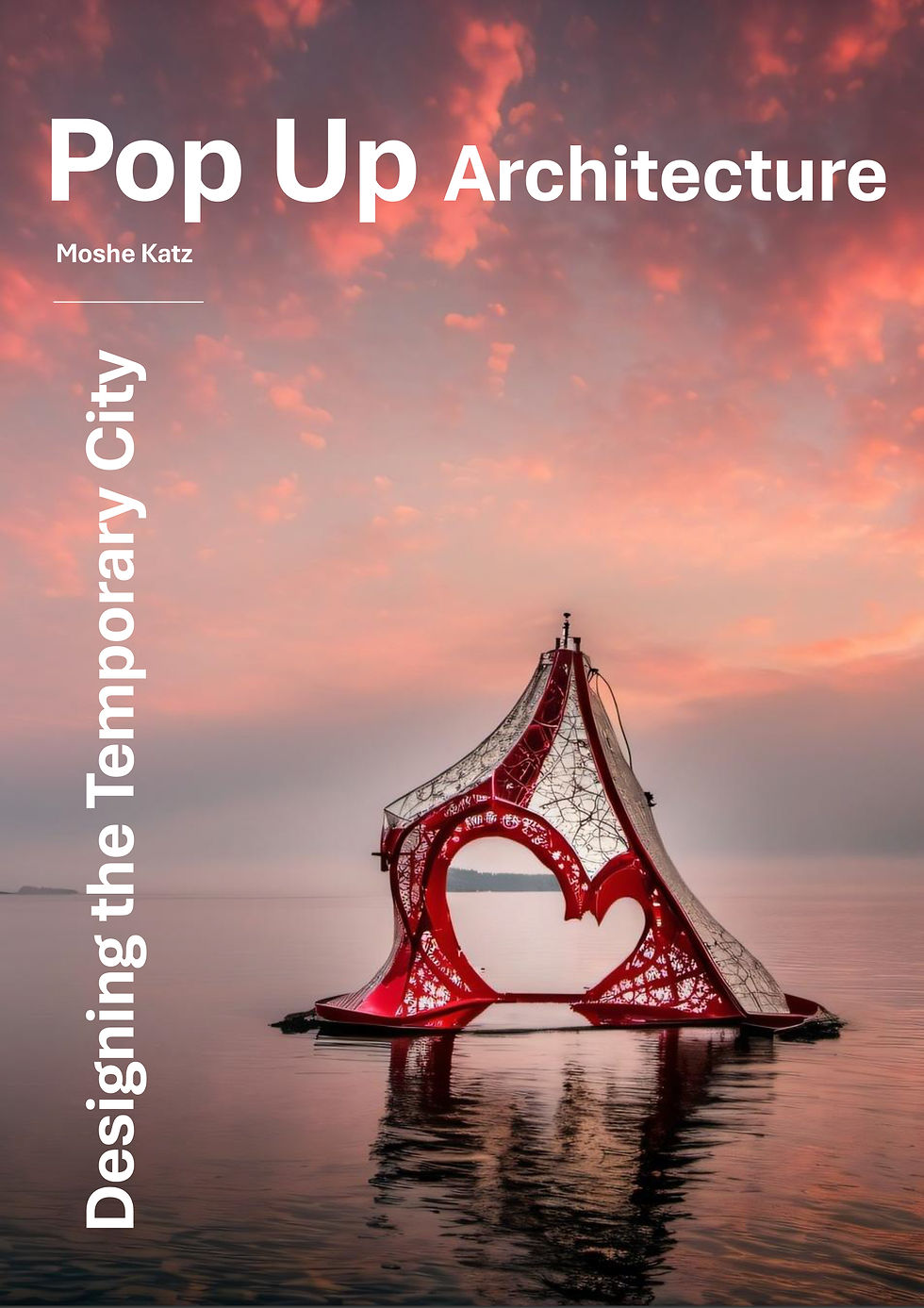
Thinking in time is central. Successful projects plan arrival, duration, and disappearance. Arrival must communicate; duration intensifies experience through scarcity; disappearance — often overlooked — can be the most transformative moment, because the absence leaves a changed perception. Pop‑up projects are experiments with low risk and high learning value: if they fail, they vanish; if they succeed, they reveal new possibilities for longer‑term change.
A set of guiding principles animates the practice: responsiveness, adaptability, immediacy, lightness, activation, precision, and imagination. These shift the designer’s role from imposing fixed solutions to orchestrating conditions for interaction. Dynamics matter: dynamic and kinetic architectures embed movement — literal or perceptual — into form so structures can change identity through light, sound, reconfiguration, or physical motion.
The city becomes a field of potential. Forgotten lots, edges between uses, underused sidewalks — these are not failures but opportunities. Pop‑up work is about reading those latent energies and inserting interventions that translate, connect, and amplify. Creativity acts as catalyst: art, performance, and local expression can reorient attention overnight, turning indifferent places into sites of belonging.
Pop‑up as social healer is one of the book’s most humane claims. Temporary interventions rebuild proximity: a shared seat, a fleeting market, a performance — these do not prescribe behavior but create conditions for encounter, and in doing so can soften loneliness and fragmentation. Because pop‑ups are ephemeral, they invite participation and lower barriers to engagement; because they are precise, they can restore dignity to neglected places.
Practical systems follow ideas: modular and mobile structures make assembly, transport, and reuse efficient and ethical; temporary living rethinks dwelling as adaptable and meaningful even when brief; architecture nomadism imagines traveling pavilions and services that carry identity across neighborhoods rather than being bound to one parcel.
The book grounds theory in projects. Case studies show how small moves — a market stall, a light canopy, a pop‑up pavilion — can multiply into urban effects far exceeding their footprint. Urban acupuncture is a vital metaphor: well‑placed, low‑cost interventions act like needles that release energy through a system, reconnecting fractured urban tissue and creating routes of renewed activity.
Mapping opportunity becomes an essential craft. The pop‑up designer maps time as much as space: when a place is alive, who uses it, which edges are porous. This listening, relational approach resists projection and prioritizes precision over proliferation. From mapping flows and emotional atmospheres grows design that is coherent and contextual.
Design principles emphasize clarity, lightness, adaptability, precision, activation, reversibility, and material intelligence. The best pop‑ups are honest about their construction, respectful of the host site, and powerful precisely because they do one thing well. At neighborhood scale, cumulative pop‑ups can transform identity, support local economies, and create adaptable routes of activity without waiting for masterplans.
The future positions pop‑up architecture not as a fad but as a permanent way of thinking: resilient, tech‑enabled, community‑driven, and environmentally conscious. Temporary interventions can respond to crises, test ideas, and diffuse innovations into permanent practice. Exercises offer a toolkit — from “reading the invisible city” to designing disappearance — that trains designers to observe, prototype, and iterate.
In the conclusion the book returns to its bold claim: architecture need not endure to matter. Temporal interventions can reshape perception, social life, and possibility. The temporary city lives layered inside the permanent one: not opposed but complementary. When designers learn to time, to tune in, and to act precisely, even a single pop‑up can shift a street, a neighborhood, or a city’s imagination.
Why this matters now: cities are faster, more mobile, and more fragile than ever. Pop‑up architecture offers an agile, human‑scaled response — a way to test, heal, and enliven urban life with interventions that are thoughtful, light, and catalytic. Read the city for its moments, design for arrival and disappearance, and you unlock a different kind of urban power — one measured in encounters, memories, and opened possibilities rather than only in stone and steel.
Learn more about Pop Up Architecture Ebook...


Comments