


Architecture Portfolio for Master’s Applicants: Showing the Architect You Are Becoming

Architecture Portfolio for Master’s Applicants: Showing the Architect You Are Becoming:
An architecture portfolio for a Master’s application should not simply be an improved version of your undergraduate portfolio. By the time you apply for postgraduate architecture studies, the question is no longer only whether you can design a building, produce drawings, make models, or create convincing images. Your previous education already provides evidence that you have studied architecture.
The much more interesting question for an admissions committee is what kind of architect you are becoming, what questions you have begun to ask independently, and where your architectural thinking might go if you are given another two or three years to develop it. This is why I believe a Master’s portfolio should not function as an archive of previous achievements. It should function as an argument about your future.
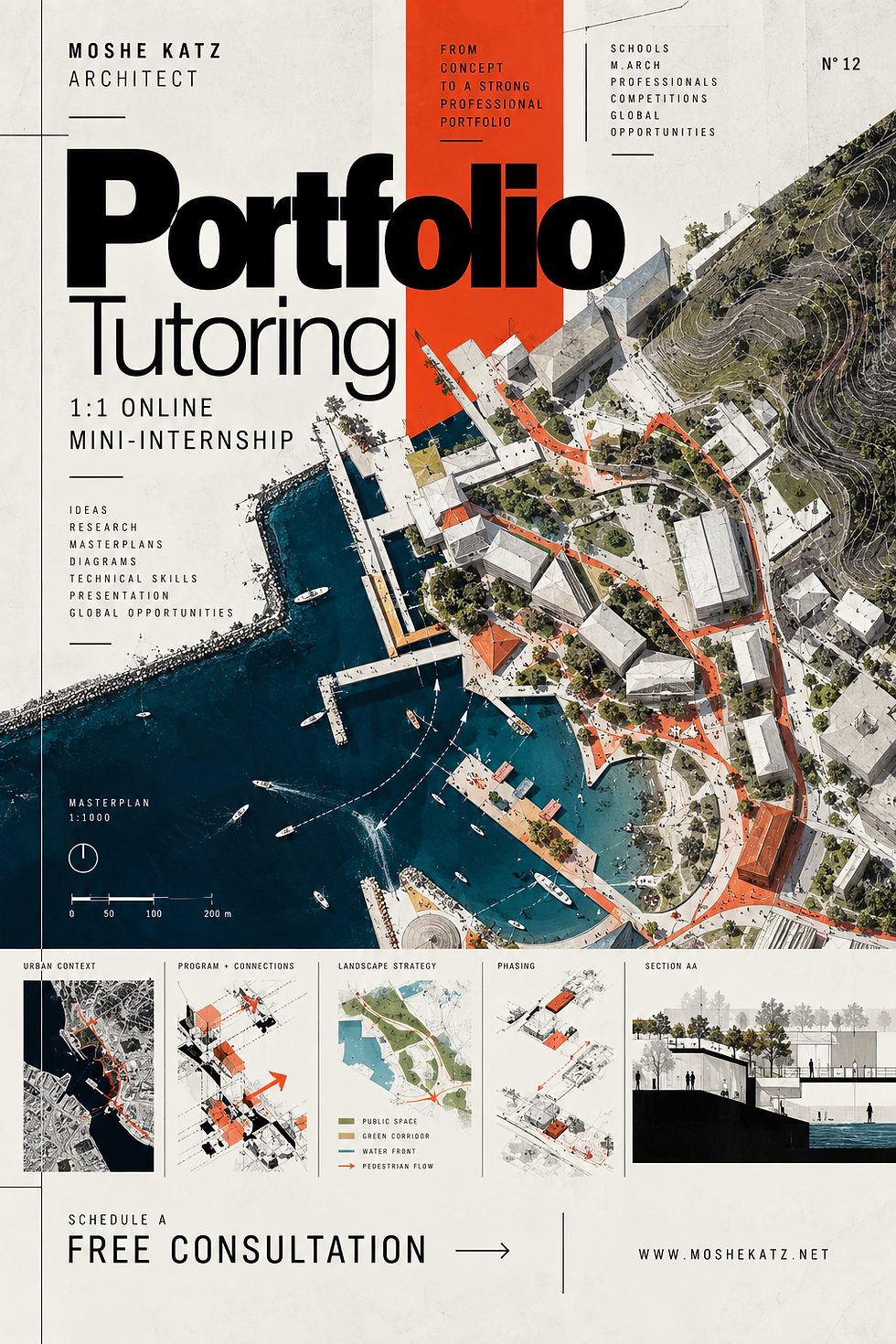
When I work with students on Master’s portfolios, one of the first things I look for is a thread that exists underneath their projects. It is rarely obvious at first. One project may be a housing project, another an urban intervention, another a cultural building, and another an experimental installation. Visually and programmatically they may appear completely unrelated, yet the student may repeatedly be fascinated by boundaries, movement, social interaction, material transformation, memory, environmental systems, technology, temporality, light, or the relationship between the individual and the city.
Finding this recurring territory is much more important than forcing all the projects to look alike. I think of it as the student's creative DNA: not a graphic style applied to everything, but a way of seeing that repeatedly generates questions.
This distinction between style and identity is particularly important. A portfolio can be beautifully designed and still tell me very little about the person who made it. Consistent fonts, colors and page layouts can create visual unity, but intellectual unity comes from somewhere deeper. When I finish looking through a strong Master’s portfolio, I should begin to recognize how this person observes the world. I should understand what attracts their attention, what they question, how they investigate something they do not understand, and how they translate that investigation into architecture. The portfolio becomes powerful when I feel that these projects could only have been produced by this particular person.
Research is an important part of this, but research should never become decoration. Architecture portfolios are full of site photographs, historical timelines, environmental diagrams and precedent studies that have almost no relationship to the architecture that follows them. I am interested in something else: whether the research actually changed the project. If you discovered something through research, that discovery should generate a question; the question should lead to an experiment; the experiment should establish a rule, relationship or possibility; and eventually that should influence geometry, structure, material, program, movement or spatial experience. I want to see the transformation from information into architecture. Research becomes meaningful when its fingerprints remain visible in the final project.
For the same reason, I often find the transitions between stages more revealing than the final image. How did an observation become a diagram? How did the diagram become a rule? How did that rule generate geometry? How did geometry become structure, and how did structure eventually create a particular human experience? A polished rendering can show me the conclusion, but it cannot necessarily show me the intelligence that produced it.
A Master’s portfolio should therefore make the evolution of the project visible. The reader should be able to reconstruct the student's thinking rather than simply admire the final result.
This also means that experimentation has an important place in a postgraduate portfolio. If your project investigates movement, what happens when you take movement seriously enough that the architecture itself begins to transform? If you are investigating boundaries, what happens when the boundary is no longer treated automatically as a wall? If you are interested in memory, can memory become sequence, repetition, absence, distortion, material or light rather than simply becoming the story behind the project?
I encourage students to push an idea further than the obvious architectural response because this is often where their individual thinking begins to appear. Experimentation is not there to make the portfolio look artistic. It exists because the answer has not yet been found.
At the same time, there is a danger in making a Master’s portfolio too polished. During the application process students often clean everything until the uncertainty, experimentation and energy of the original project disappear. I believe the opposite is sometimes necessary.
Improve the drawings, strengthen the sections, redesign the diagrams, clarify the hierarchy and remove unnecessary material, but protect the moments of discovery. A rough model that changed the direction of a project may tell me more about you than another perfect render. An unsuccessful experiment may be worth showing if it led to an important realization. The objective is not to display failure for its own sake, but to demonstrate that you know how to transform uncertainty into knowledge.
The portfolio itself should also be understood as a design project. I think about it almost as an exhibition or a spatial sequence. It has an entrance, rhythm, density, pauses, moments of discovery and a conclusion. Not every page should scream for attention. Some pages should establish information, others should slow the reader down, and a few should create memorable moments. Editing therefore becomes as important as production. Sometimes the greatest improvement I can make to a student's portfolio is not adding another project but removing one that weakens the larger argument. The important question is not how much work can fit into the portfolio, but how little is necessary to reveal the strongest possible version of the person behind it.
Ultimately, I believe the most successful Master’s portfolio creates curiosity about the applicant's future. The admissions committee should not finish thinking only, "This student has produced good architecture." Ideally, they should wonder what this person could become inside their school. A strong portfolio demonstrates ability, but beyond ability it reveals independence, curiosity, depth, experimentation and an emerging architectural position.
It should not simply say, "These are the projects I have made." It should communicate something much more personal and much more ambitious: this is how I see, this is how I investigate, this is how I transform ideas into space, and this is where my architecture might go next.


Comments