


What Can We Learn from the Architecture of Spiritual Retreats?

Updated: Aug 29
There is something fascinating about entering a spiritual retreat. Before anyone explains its philosophy, before meditation begins, before a ritual takes place, architecture has already started working on us. The distance from the city, the path toward the building, the sound of footsteps, the changing light, the first glimpse of water, the relationship with the horizon and the silence between spaces begin to alter our awareness. We may arrive carrying the speed and noise of ordinary life, but gradually something changes. We begin to notice where we are. We begin to notice nature. Eventually, if the architecture succeeds, we begin to notice ourselves.
This is why the architecture of spiritual retreats is so important for architects and designers to study. A spiritual retreat is not simply another architectural typology. It is almost a laboratory for understanding how space affects consciousness. It allows us to examine architecture when its purpose goes beyond shelter, efficiency and function and asks a much deeper question: how can a physical environment create an inner transformation?
In my approach to Spiritual Architecture, spirituality is not synonymous with religion. Spiritual architecture can exist within any function or architectural typology because it is fundamentally concerned with discovery and with creating meaningful relationships between people and themselves, other people, their environment and the larger universe or creation. A spiritual retreat makes these relationships particularly visible because the architecture itself becomes part of the journey toward connection.
A Spiritual Retreat Is a Transition, Not Just a Destination
One of the first lessons we can learn from retreat architecture is that meaningful architecture does not begin when we enter the building. It begins much earlier.
Imagine approaching a retreat hidden within a forest, desert, mountain or coastline. The road becomes narrower. The familiar disappears. Perhaps the car must be left behind. We continue walking. The sounds change. Architecture appears only partially between trees or rocks. We cross a threshold and enter a darker passage before discovering an open courtyard filled with sky.
The retreat has already begun.
This is architectural storytelling.
The journey from one state of awareness toward another can become the real program of the building. My Spiritual Architecture methodology describes the hidden as an experience created through layering, filtering and different degrees of exposure. Instead of revealing everything immediately, architecture offers signs, glimpses and clues, creating a gradual journey from detachment through entrance and path toward revelation.
For architects and architecture students, this offers an important creative lesson. Stop thinking only about rooms and start thinking about transitions. Ask what a person feels ten meters before entering your architecture. Ask what disappears, what becomes visible, what remains hidden and what is finally revealed.
A building can be an object.
A retreat teaches us that architecture can become a journey.
What Can We Learn from the Architecture of Spiritual Retreats?
The deeper answer to What Can We Learn from the Architecture of Spiritual Retreats? is that architecture can change our state of being without explaining anything to us.
This is one of architecture's extraordinary powers.
A spiritual retreat does not need a sign saying, “become silent.” Architecture can slow movement through proportion, material, acoustics and light. It does not need to tell us to contemplate nature. It can frame a single tree so precisely that we suddenly see that tree differently. It does not need to explain infinity. It can place the human body against an immense horizon, vertical opening or unexpected void and allow scale to produce the experience.
In my methodology, spiritual scale is not simply about making something large. Scale is understood as a relationship between the parts, the whole and the person perceiving them. When scale moves beyond our expected reference, the physical extension of space can produce an inner transformation and create new relationships between the person, architecture and sky.
This means that architects are not simply composing objects.
We are composing relationships.
Silence Is an Architectural Material
We usually imagine architectural materials as concrete, timber, stone, steel or glass. Spiritual retreats teach us to expand this vocabulary.
Silence can be a material.
Emptiness can be a material.
Shadow can be a material.
Distance can be a material.
Time can be a material.
The void can be a material.
In my exploration of spiritual experience through architecture and film, emptiness is understood as something that draws us inward, while silence changes perception and expands awareness. Ritual and repetition can deepen meaning, and light or shadow can become protagonists rather than background effects.
This is extremely important for conceptual architecture design because students are often trained to think that design means adding things. More form, more detail, more material, more geometry and more visual information can easily become confused with more architecture.
Spiritual retreat design teaches almost the opposite.
Sometimes the most powerful architectural decision is removal.
A completely empty room containing only changing sunlight may affect us more deeply than an elaborately decorated interior. A narrow opening toward the landscape may be stronger than a transparent glass wall revealing everything. A silent courtyard containing one stone and one tree may contain more emotional intensity than a space crowded with architectural gestures.
The architecture becomes powerful because it creates attention.
Nature Should Not Decorate Architecture
Many contemporary buildings claim to connect with nature because they contain plants. Spiritual retreat architecture suggests a more radical relationship.
Nature should not merely decorate architecture. Nature can become a coauthor of architecture.
The sun changes the space. Rain transforms its sound. Wind activates fabric, leaves or water. Reflections bring the exterior inward. Seasons continuously rewrite color and atmosphere. Instead of protecting architecture from change, the architect can invite change to participate.
This relates directly to what I call synchronicity in architecture, where the person, environment, building, sun and other phenomena become participants in a responsive system. The goal is not to merge everything into sameness but to allow each element to retain its identity while adjusting to the others. Architecture becomes a living partner rather than a static object.
The lesson for designers is enormous.
Do not ask only, “What building should I place in this landscape?”
Ask, “What relationship could happen here?”
Light Can Become the Main Character
Few architectural typologies reveal the emotional power of light as clearly as spiritual retreats.
Light can guide movement, establish hierarchy, reveal texture, mark time, dissolve boundaries and create moments of revelation. In spiritual architecture, light can become more than illumination. It can become the story itself.
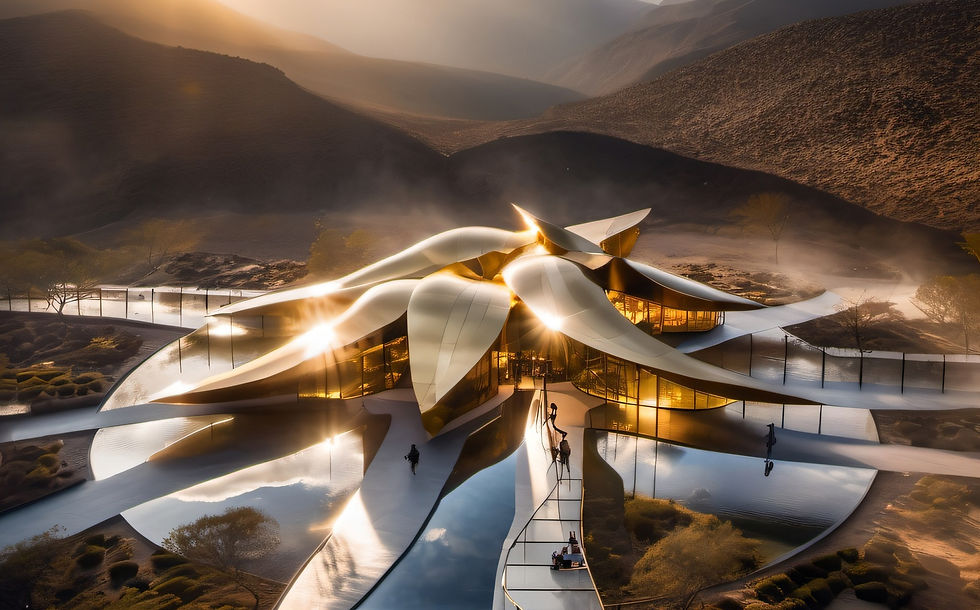
My Light Flower retreat concept explores precisely this possibility. The retreat is imagined as a sanctuary for meditation, spiritual practice, knowledge and healing, inspired by the movement of a flower opening and closing toward a point of vertical connection. In its Tokyo interpretation, different spaces are interconnected through light and move toward a central vertical light that creates unity.
This suggests a powerful creative exercise for any architecture student: imagine removing conventional program labels from your project and designing around a phenomenon instead.
What if your project were organized around the journey of sunlight?
What if the central protagonist were wind?
What if the building followed the movement of water?
What if the entire architecture were generated by the changing shadow of one tree?
Suddenly architecture begins to move beyond composition toward storytelling.
Spiritual Retreats Teach Us the Power of the Void
One of the most difficult things for young designers to understand is that nothingness can contain enormous architectural intensity.
We instinctively want to fill space. Yet retreat architecture often gives importance to what is absent. The courtyard, opening, gap, pause and unoccupied center can become the most meaningful parts of the project.
Within my Spiritual Architecture methodology, the void and absence are connected with experiences of timelessness and spacelessness. When conventional markers of time, boundaries and spatial definition begin to disappear, architecture can approach a continuous or infinite experience.
This transforms how we think about composition.
Instead of designing objects and leaving space between them, we can design the space between things.
The void becomes active.
It gathers people around itself. It frames the sky. It allows light to descend. It creates distance. It introduces mystery. It gives architecture room to breathe.
Architecture Can Create Ritual Without Becoming Religious
A retreat also teaches us about ritual. Ritual is simply an action that has acquired meaning through attention and repetition.
Walking toward water can become ritual. Removing shoes can become ritual. Sitting beneath a particular opening can become ritual. Watching sunset from the same place can become ritual. Crossing a dark threshold before entering light can become ritual.
Architecture can intensify these actions.
This is why spiritual architecture does not require religious symbolism. The spiritual quality can emerge through the experience itself. My methodology defines the role of spiritual architecture as responding not only to physical needs but also to the soul, reconnecting people with a sense of infinity and with their place in the world.
For me, this is where architectural storytelling becomes especially powerful. The architect can choreograph an emotional sequence through space without forcing a single interpretation upon the visitor.
The Retreat Is a Lesson in Designing the Invisible
Perhaps the greatest lesson spiritual retreats offer architects is that some of the most important things we design cannot be photographed.
We design anticipation.
We design curiosity.
We design stillness.
We design intimacy.
We design awareness.
We design the moment when somebody suddenly looks upward.
This is where architecture becomes much more than formal manipulation. The visible building becomes an instrument for creating invisible experiences.
The purpose of spiritual space, within my approach, is to inspire and connect people with a higher sense of meaning, while creativity and intuition become methods for reaching beyond purely rational design.
This is also the foundation of the way I work with architecture students and designers through architectural tutoring and creative mentorship.
Learning to Think Like a Spiritual Architect with Moshe Katz Architect
When I mentor an architecture student, I am not interested only in improving the project sitting on the screen that day. I want to develop the person who will create hundreds of projects in the future.
That distinction changes everything.
My tutoring approach searches for the student's individual creative language and then develops tools for translating that language into architecture. We work through creative research, conceptual thinking, intuitive and conceptual sketching, architectural storytelling, diagrams, model making, atmosphere, material experimentation and visual communication. The objective is not to copy my architecture or anybody else's architecture. It is to discover the student's own architectural DNA and strengthen their ability to transform an invisible idea into a powerful spatial experience.
This is precisely what the architecture of spiritual retreats can teach us.
Instead of beginning with the question, “What should my building look like?” we can begin with much more fertile questions. What should this architecture make someone discover? What relationship should it create? What should remain hidden? Where should time slow down? Where should nature become stronger than architecture? Where should light become the protagonist? What should the visitor remember after leaving?
These questions can transform an architecture school project, an admission portfolio, a professional portfolio and eventually an entire architectural career because they develop something deeper than style.
They develop a way of seeing.
From Designing Buildings to Designing Transformation
The architecture of spiritual retreats reveals a possibility that is relevant far beyond meditation centers or sanctuaries. Its principles can enter a house, hotel, school, museum, hospital, public space or even a skyscraper because spirituality in architecture is not defined by function. It is defined by the relationships and experiences architecture creates.
A school can contain a place of silence. A house can frame the changing seasons. A hotel can transform arrival into ritual. A hospital can use gardens, light and views to create moments of reconnection. A public building can create a relationship with the horizon that makes people momentarily aware of something beyond themselves.
This is ultimately what we can learn from the architecture of spiritual retreats. The retreat teaches us that architecture does not have to compete for our attention. It can deepen our attention. It does not have to overwhelm us with form. It can reveal what was already present but unnoticed. It does not have to separate us from nature. It can place us back into conversation with it.
Most importantly, it reminds architects that we are not only designing buildings.
We are designing encounters between people and light, between bodies and scale, between memory and matter, between silence and sound, between nature and human creation, between what can be seen and what can only be felt.
And somewhere inside those encounters, architecture begins to become spiritual.
From the Online course: " spiritual Architecture" by Moshe Katz Architect. Learn more here: https://www.moshekatz.net/challenge-page/spiritual-soulful-poetic-architecture-course?programId=c4aef34c-f629-4f86-bd14-072ca21f30d9
#SpiritualArchitecture #SpiritualRetreats #RetreatArchitecture #MosheKatzArchitect #ArchitectureTutor #ArchitectureMentoring #ArchitectureStudents #ArchitectureEducation #ArchitecturalStorytelling #ConceptualArchitecture #CreativeArchitecture #ArchitectureDesign #MeditationArchitecture #HealingArchitecture #SacredSpace #SpiritualSpaces #ArchitectureAndNature #LightInArchitecture #VoidInArchitecture #SilenceInArchitecture #ArchitectureAndEmotion #ArchitectureAndWellbeing #IntuitiveDesign #CreativeThinking #ArchitecturePortfolio #ArchitectureInspiration #SpatialExperience #MeaningfulArchitecture #ArchitectureOfTheSoul


Comments