


Who Is a Spiritual Architect?

Updated: Aug 29
An architect can design a building, organize space, compose a façade and transform materials into form. A spiritual architect searches for something beyond all of these things. The spiritual architect asks what architecture can awaken in a human being. What can a space make us feel about ourselves, about nature, about other people and about our place within something larger than ourselves? Can architecture create silence without demanding silence? Can it make us suddenly aware of the sky? Can a building make time disappear for a moment? Can light, scale, emptiness and movement allow us to experience something that cannot easily be explained in words?
This is where spiritual architecture begins. It is important to understand that spiritual architecture does not mean religious architecture. A spiritual architect does not necessarily design churches, temples, mosques or sacred buildings. Spirituality can become part of any architectural typology because it concerns the relationship between human experience and space. In my approach, spirituality in architecture creates relationships between the person and themselves, the person and others, the person and the environment, and ultimately the person and the universe or creation.
The question Who Is a Spiritual Architect? therefore has a much larger answer than a professional definition. A spiritual architect is someone who sees architecture not simply as the construction of objects, but as the construction of relationships, experiences and states of consciousness.
Who Is a Spiritual Architect?
In my philosophy, the spiritual architect is an architect who attempts to elevate the material world toward its spiritual dimension. This architect uses the creative mind to search for the origin, the DNA and the soul of things. Instead of accepting matter only for what it already is, the spiritual architect asks what it could become. Architecture becomes a place where matter can dream, evolve and reveal another potential, and design becomes a way of imagining an alternative way of being in the world.
This distinction changes the entire creative process.
A conventional architectural question might be, “What should this building look like?” The spiritual architect asks, “What should this building allow us to experience?” Instead of beginning with an image, the process begins with an invisible intention. Perhaps the project is about infinity. Perhaps it is about unity. Perhaps it explores memory, silence, transformation, connection with nature, disappearance, revelation or the feeling of moving beyond oneself.
Only after discovering this deeper intention does the architect begin searching for its physical language.
This is one of the most important ideas I teach architects and architecture students. Do not begin with architecture. Begin with the question that architecture must eventually embody.
A Spiritual Architect Designs Experiences, Not Only Objects
One of the limitations of architectural education is that students can become obsessed with the object. They think about the shape of the building, its geometry and how impressive it will appear in a rendering. Yet the person who eventually enters architecture does not experience a building as an isolated object. They experience sequences, distances, proportions, light, darkness, temperature, views, materials, sounds, movement and moments of discovery.
For this reason, the spiritual architect thinks in terms of experience.
Imagine approaching a building without seeing its entrance immediately. A narrow opening draws you toward it. The exterior world slowly disappears. Light becomes weaker. The ceiling lowers. You become conscious of your body and your footsteps. Then the space suddenly opens upward and an enormous fragment of sky appears above you.
The architecture has told a story without using a single sentence.
This relationship between architecture and storytelling is fundamental to my design methodology. The spiritual architect composes a journey in which something is gradually revealed. The hidden can be created through layering, filtering, clues and partial exposure, allowing architecture to unfold rather than explain itself immediately.
The spiritual architect therefore understands mystery as an architectural material.

The Spiritual Architect Works With the Invisible
Stone is visible. Concrete is visible. Glass is visible. Yet some of the most powerful architectural materials cannot be held in our hands.
Light can become material.
Void can become material.
Time can become material.
Scale can become material.
Silence can become material.
Reflection can become material.
The horizon can become material.
The spiritual architect learns to design with these invisible forces because architecture is not created only by what exists. It is equally shaped by relationships between things and by what appears to be absent.
In my Spiritual Architecture methodology, infinity can be approached through abstraction, changing relationships, void, light, circles, domes, scale and precise intention. The goal is not to use these elements as a stylistic formula. There is no single appearance that makes architecture spiritual. Their purpose is to help the architect translate something intangible into spatial experience.
This is a crucial distinction. Spiritual architecture is not a style.
It is a way of seeing.
Creativity and Intuition Become Architectural Tools
To become a spiritual architect, creativity cannot remain something we use only when we need an unusual form. Creativity becomes a way of accessing possibilities beyond what logic already knows.
My course describes creativity as an expression of the spiritual dimension and intuition as a direct connection that can guide creation beyond pure logic and reason. This does not mean abandoning intelligence or architectural knowledge. It means recognizing that knowledge alone usually reproduces what is already known.
If you begin every project by searching for architectural precedents, you may become extremely skilled at understanding architecture that already exists. But the spiritual architect also needs to ask questions for which precedents may not yet exist.
What does a wall dream of becoming?
What does darkness reveal that light cannot?
What happens if the void becomes more important than the building?
What would architecture become if nature were not controlled by the building but became its equal partner?
What happens if a person does not simply occupy a space but participates in creating it?
These questions push design toward discovery.
Nature Is a Partner, Not a Background
A spiritual architect does not simply place architecture into nature and then add vegetation to make the project appear connected to its environment. The relationship must go deeper.
In my philosophy, harmony exists when different elements maintain their autonomy while influencing one another without domination. In spiritual architecture this can become a balanced relationship between human beings, nature, architecture and the sky.
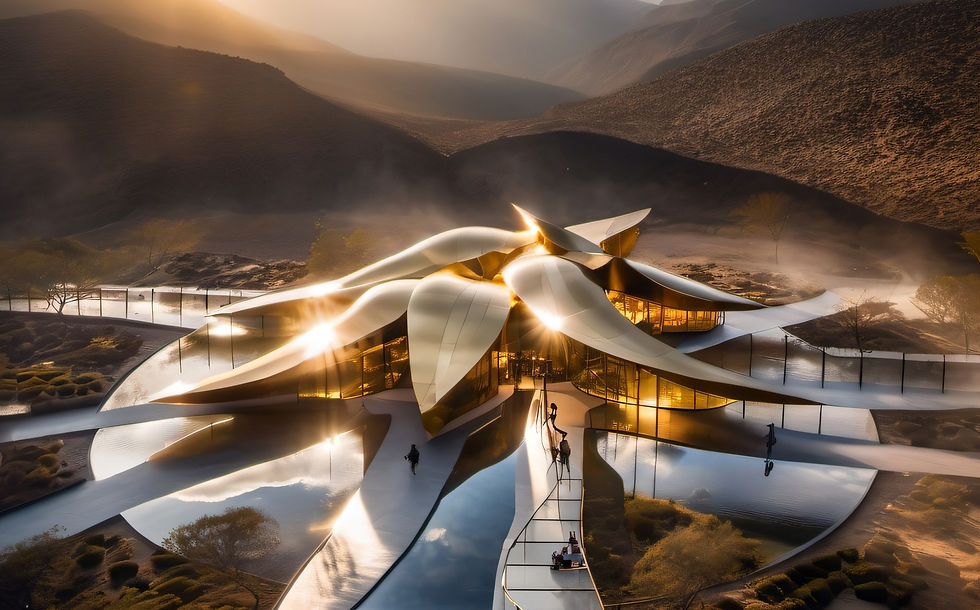
Imagine architecture in which sunlight changes the experience throughout the day, wind moves parts of the building, vegetation enters spaces unexpectedly, water reflects architecture into another dimension and the human body becomes another moving element within this composition.
Now the building is no longer a finished object.
It is participating in reality.
I describe this relationship through synchronicity in architecture, where the person, environment, structure, sun and changing phenomena such as reflections or seasons remain autonomous but subtly adjust to one another. Architecture becomes a responsive system and space becomes a living partner in experience.
This is a very different way of thinking about sustainable architecture or architecture inspired by nature. The goal is not merely to place nature around architecture. It is to create a relationship in which architecture and nature transform one another.
A Spiritual Architect Designs the Void
One of the most profound shifts an architecture student can make is learning that emptiness is not leftover space.
The void can become the project.
A spiritual architect understands that the architecture we remember most strongly is often not the wall itself but what the wall allowed us to experience. A vertical opening makes us see the sky differently. A dark corridor intensifies the light waiting at its end. An enormous empty chamber changes our perception of our own body. A silent courtyard makes us aware of wind, footsteps and distance.
The spiritual dimension can emerge precisely through what has been removed.
My methodology connects void and absence with timelessness and spacelessness. Spaces without clear boundaries, shadows, corners or obvious indicators of passing time can begin to challenge ordinary human perception and suggest continuity or infinity.
This is why the spiritual architect must become sensitive not only to form but also to non form, not only to presence but also to absence.
Scale Can Expand the Self
Scale is another extraordinary architectural instrument. When architecture remains close to the body, we feel our individuality strongly. When space expands dramatically beyond human scale, our relationship with ourselves begins to change.
The course describes scale as a field of spatial relationships. Smaller spaces can strengthen the sense of “I,” while larger scales can move perception toward unity and infinity.
This explains why standing beneath an immense dome, looking upward through a monumental opening or facing an enormous horizon can produce an emotional response that is difficult to describe. The architecture temporarily changes the proportion between ourselves and the world.
The spiritual architect understands that dimensions are therefore not only numbers.
Dimensions can transform consciousness.
The Spiritual Architect Searches for the Soul of Things
Perhaps the most important quality of a spiritual architect is curiosity toward the hidden potential of reality.
Most people look at a stone and see a stone. A creative architect asks what can be made from it. A spiritual architect can go even further and ask what the stone wants to become.
This question may sound poetic, but it contains an extremely powerful design methodology. Instead of imposing our first idea upon materials, places and phenomena, we begin listening to them. We study their character, movement, contradictions, histories and possibilities. We search for their creative DNA.
Architecture then becomes an act of discovery rather than domination.
This is also why I believe becoming a spiritual architect is connected to becoming a more personal architect. The goal is not to copy a recognizable architectural language. It is to discover your own relationship with space, nature, light, infinity, memory, emotion and human experience.
Learning Spiritual Architecture With Moshe Katz Architect
When I tutor architects, designers and architecture students, I am not interested in teaching them how to reproduce my architecture. I want them to discover the architecture that only they can create.
This is what makes my architectural tutoring and mentoring methodology different. We do not begin by asking how to make a project look more professional. We begin by searching for the deeper creative identity behind the work. I want to understand what repeatedly fascinates you, what kinds of spaces you intuitively create, which emotions appear in your sketches, what you notice that other people overlook and which questions may become the foundation of your architectural language.
From there, we develop the ability to transform abstract ideas into architecture through conceptual thinking, intuitive sketching, creative research, diagrams, model making, spatial experimentation and architectural storytelling. The purpose is not merely to improve one university project, portfolio or presentation. It is to develop a personal design methodology that can continue serving you throughout your architectural career.
This is especially important today. Technical knowledge is increasingly accessible, digital tools are becoming extraordinarily powerful and artificial intelligence can generate impressive architectural images within seconds. The future architect therefore needs something deeper than technical production. The architect needs vision.
Your ability to imagine what does not yet exist becomes increasingly valuable.
Your ability to ask original questions becomes valuable.
Your ability to discover relationships others do not see becomes valuable.
Your ability to transform an invisible idea into an unforgettable spatial experience becomes valuable.
This is where spiritual architecture and creative architectural mentoring meet.
Becoming a Spiritual Architect
So, Who Is a Spiritual Architect? A spiritual architect is not someone who has mastered a particular aesthetic. It is someone who has learned to look beyond the visible surface of architecture and search for the relationships hidden beneath it.
It is an architect who understands that a building can connect a person with themselves, with other people, with nature and with creation. It is an architect who sees light as more than illumination, emptiness as more than unused space, scale as more than measurement and nature as more than landscape. It is someone willing to explore infinity, unity, mystery, transformation, synchronicity and timelessness as architectural questions.
Most importantly, the spiritual architect understands that architecture can do more than accommodate life.
Architecture can expand life.
This is the direction I explore in my Spiritual Architecture course and in my personal architectural tutoring and mentoring with Moshe Katz Architect. For students, architects and designers who feel that architecture should contain something deeper than function and appearance, the journey begins by discovering your own creative DNA and learning how to translate it into space.
You do not become a spiritual architect by learning a style.
You become one by learning how to see what architecture has not yet become.
From the online "spiritual architecture course" by Moshe Katz Architect- Learn more here:
#SpiritualArchitect #WhoIsASpiritualArchitect #SpiritualArchitecture #MosheKatzArchitect #ArchitectureMentoring #ArchitectureTutor #ArchitectureStudents #ArchitectureDesign #ConceptualArchitecture #CreativeArchitecture #ArchitectureStorytelling #ArchitecturalThinking #ArchitectureAndSpirituality #ArchitectureOfTheSoul #SoulSpaces #VisionaryArchitecture #FutureArchitecture #ArchitectureAndNature #LightInArchitecture #VoidInArchitecture #ArchitectureOfInfinity #ArchitecturalExperience #IntuitiveDesign #CreativeThinking #DesignMentoring #ArchitectureEducation #ArchitectureInspiration #PersonalDesignLanguage


Comments